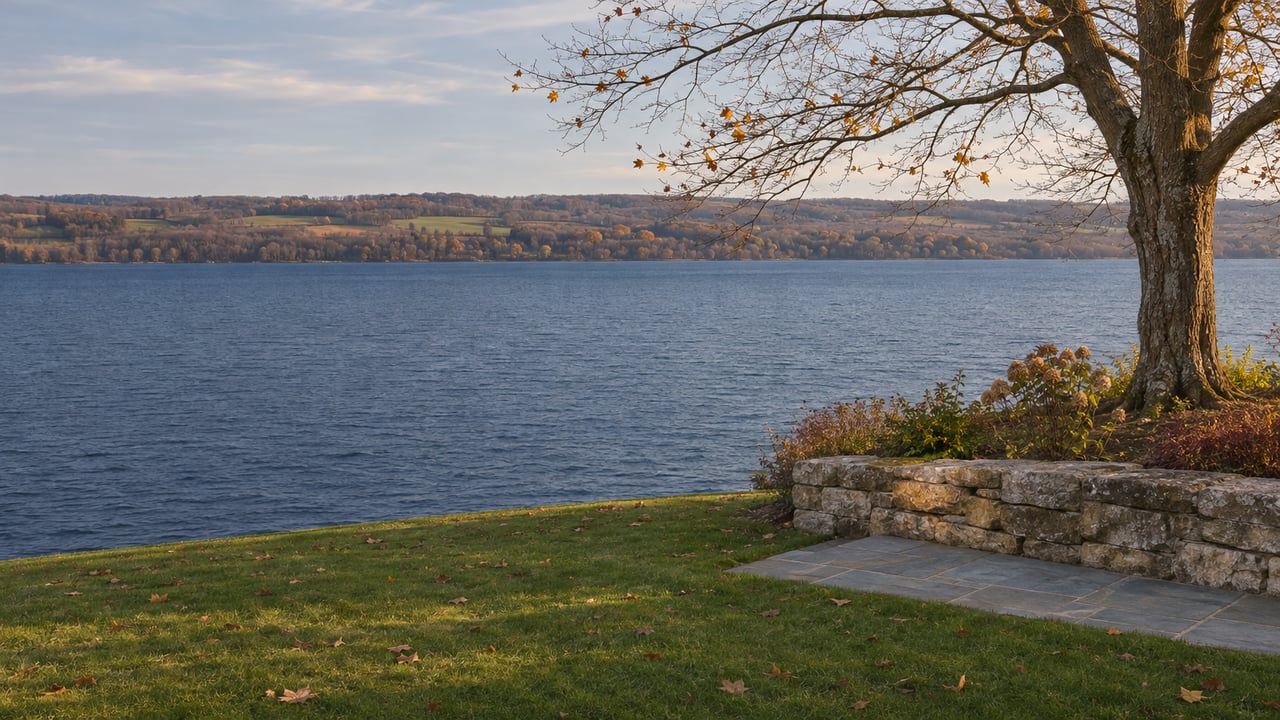
Geneva's New Short-Term Rental Tax, and the City-Town Line That Matters More on Seneca Lake
November 12, 2026
November 12, 2026
Say you plan to rent out a Seneca Lake house on the weeks you aren't using it. If that house is near Geneva, which rule decides whether you can? Geneva's City Council approved a 3% tax on short-term rentals at its Nov. 4 meeting. For a buyer who won't live at the property, though, the rule that comes first sits in the Town of Geneva's code. It applies on one side of a municipal boundary and not the other.
In December 2022, the Town of Geneva adopted a short-term rental law. Under it, you need a permit before you rent. A permit lasts three calendar years, and the permit fee is paid each year in years two and three.
The most important part for a second-home buyer is the owner requirement. Under Chapter 123 of the Town of Geneva code, every new short-term rental must be "owner-occupied" or "owner-supervised." Owner-occupied means at least one owner on the title lives in the dwelling for at least seven months of each calendar year, either in part of the rental itself or in another dwelling on the same lot. Owner-supervised means that owner lives at least seven months a year on a lot next door or directly across the street.
That takes the most common second-home plan off the table for new permits. In the classic version, the owners live in Rochester, Buffalo or out of state, come up for a few summer weeks, and rent the house out otherwise. In the town, that household wouldn't qualify for a new permit unless an owner also lives on the parcel or right beside it for most of the year.
The code includes a grandfather clause. The owner standard "shall not apply to any short-term rental permit, or renewal thereof, in existence on the date the local law enacting this standard takes effect." It applies only to permits issued after that date. In practice, two houses on the same stretch of town shoreline can have very different rental rights. One may carry an older permit that predates the owner rule, while the one next door would have to meet it from scratch.
Town permits also come with practical requirements: an inspection, safety systems, parking and, where it applies, a recent septic review. Occupancy is capped at two people per qualifying sleeping room and can be lower if the septic system limits it. On a lake property, the septic system can set the real guest count no matter how many beds are in the house.
The City of Geneva regulates short-term rentals differently. Its licensing article was added by Ordinance No. 1-2024 on July 10, 2024, and took effect 150 days after adoption. The city's short-term rental licensing code and its zoning provisions set conditions on how a rental operates, but they include no rule that the owner live at or next to the property.
Here is what the city does require:
The city has also eased its rules once already. When the registry went live, the Finger Lakes Times reported that the revised code dropped an earlier special-use permit requirement and changed parking rules to match ordinary residential use. The paper also reported the permit cost at launch: $250 per dwelling unit for two years, with the city's inspection included. The registration portal is on the city's Short-Term Rentals page.
| City of Geneva | Town of Geneva | |
|---|---|---|
| Governing law | Ord. No. 1-2024, adopted July 10, 2024 | L.L. No. 7-2022, adopted Dec. 13, 2022 |
| Owner residency for new permits | No such condition in the code | Owner-occupied or owner-supervised, at least seven months a year |
| Older permits | Not applicable | Exempt from the owner rule if in place before it took effect |
| Occupancy limit | Four rented bedrooms; lesser of 10 guests or bedroom capacity | Two people per qualifying sleeping room, subject to septic |
| Permit term | License per unit, valid two years from issue | Three calendar years, fee paid annually in years two and three |
| New 3% short-term rental tax | Approved at the Nov. 4 Council meeting | Not part of the city's vote |
The tax applies only on the city side of that line. The Finger Lakes Times reported that Geneva City Council voted 8-0 at its Nov. 4 meeting to put a 3% tax on each short-term rental transaction. Mayor Jim Cecere framed it as a matter of fairness. Hotel and bed-and-breakfast guests already pay the city's 3% occupancy tax, and in the mayor's words to the paper, short-term rental guests "should pay the same tax."
According to the same report, Cecere said rental companies such as Airbnb will collect the tax, not individual owners, and the money will go toward infrastructure. He also said city staff will come back with an implementation timeline over the next few months. As of this post, the tax is approved law, and the city is still working out how it will roll out.
The tax was once set aside. In the Finger Lakes Times' account of the registry launch, the occupancy tax was dropped from the city's short-term rental regulations because, at the time, it was understood to require an act of the State Legislature. This fall, Cecere told the paper he had consulted the New York State Conference of Mayors and worked with city attorney David Hou, and that "we already have state authorization to collect an occupancy tax."
The rate puts Geneva in line with Canandaigua at the other end of Ontario County. The paper noted that the City of Canandaigua charges a 3% occupancy tax on all lodging, short-term rentals included.
Ontario County adds its own layer. The county's 2008 room-occupancy local law sets a 3% tax on hotel and motel room rent and defines a hotel broadly as a facility that provides overnight lodging. It also exempts permanent residents and any facility with three or fewer rentable units.
So a Geneva hotel covered by both laws pays the city's 3% and the county's 3%. A single lake house is a different case, because the county's small-facility exemption is written into the same law. How much tax ends up on a guest's bill depends on the property, and buyers shouldn't assume one combined rate for every rental around Geneva.
For a buyer weighing rental income, the 3% city tax is real, but it is collected through the platform and paid by the guest. The town's owner-occupancy rule is a different kind of rule. It decides whether a non-resident owner can get a new permit at all, and no tax rate changes that.
Since the rules differ on each side of the line, comparing two Seneca Lake properties near Geneva comes down to a short list of questions to settle early:
This post is general information, not legal, tax or financial advice. Rules like these change and their application depends on the property, so please confirm your own situation with the City or Town of Geneva and with an attorney or accountant.
Does Geneva's new tax apply right away? Council approved it on Nov. 4. The mayor said city staff will bring back an implementation timeline over the next few months, according to the Finger Lakes Times.
Who pays it? It applies to each short-term rental transaction. The mayor said platforms such as Airbnb will collect it, not owners.
Does the city require owners to live at the rental? The city's licensing and zoning provisions don't include an owner-residency condition. The Town of Geneva's law does, for permits issued after its owner rule took effect.
If you're looking at Seneca Lake second homes near Geneva and occasional rental income is part of the plan, I'm glad to help you sort out which side of the city-town line a property sits on and what that means before you make an offer. Reach out to Stacie Whitbeck and let's connect.
There are two ways to think about remodeling projects that will boost your home’s value!
Most homebuyers start the process anxious, excited, nervous, and some are downright terrified.
Connect with a real estate professional who values trust, insight, and personal attention. Every step is guided by a deep understanding of what “home” truly means.
Get In Touch With Our Team To Learn More
Stacie Whitbeck
ADDRESS 1800 Rochester Rd, Ste 200 Canandaigua, NY 14424